Does your strategy need a scoreboard?
Growing up I've always played team sports, more for the collaboration and camaraderie than the competition against the opposing team ... of course, winning is always nice ;-)
I'm actually very self-competitive, meaning, I want to be a better me today than I was yesterday. I'm less focused on competing with or against others. I am not a good fit for a highly competitive, win at all costs, incentivised sales team. Where do you see yourself on a scale of competitiveness?
How do you know your team or you have won, or even are simply better today than yesterday? The answer is simply: metrics and scoreboards.
Here’s how a scoreboard changes behaviour: in 1998 McDonald’s rebuilt its kitchen around “Made For You”, a just-in-time system that assembles burgers after you order. That pivot did not just add a new kit. It rewired what restaurants measured: not only speed and accuracy but freshness, made-to-order compliance and holding times. Franchisees who adopted the new metrics saw better service with hotter food because their day-to-day attention mirrored the strategy they were executing. The original playbook, QSC&V, had already hard-wired Quality, Service, Cleanliness and Value into audits and mystery shopper reviews. When the strategy shifted, the scoreboard shifted with it. That is the point. (1)
When teams track what the strategy needs, execution accelerates. The fastest way to give people line of sight from their daily work to enterprise priorities is a visible, strategy-linked scoreboard that turns activity into outcomes. The Balanced Scorecard has shown for decades that strategy becomes real when it is translated into a small set of measures across financial, customer, process and learning perspectives.(2)
The Strategy-to-Scoreboard Cascade
Strategy map. Clarify enterprise objectives.
Team objectives. Translate the few strategic objectives your team materially drives. Line of sight matters because employees who understand strategy focus effort and commit more.
Key results and measures. Make goals specific and challenging and tie them to feedback. Goal-setting theory is unequivocal on the performance lift. (4)
Scoreboard. Publish a short set of leading and lagging indicators. Operational transparency increases engagement and performance when people can see the work.
Proof: The mirror matters
Drive-thru brands live and die by what they measure. Every year, QSR Magazine and Intouch Insight (3), run a national mystery-shopper study scoring speed, accuracy and experience. Chains that obsess over those categories improve where it counts because the scoreboard keeps everyone’s eyes on the same prize. The specifics vary by year, yet the principle holds: measured drivers move.
What should you start measuring from today, {{contact.first_name}}?
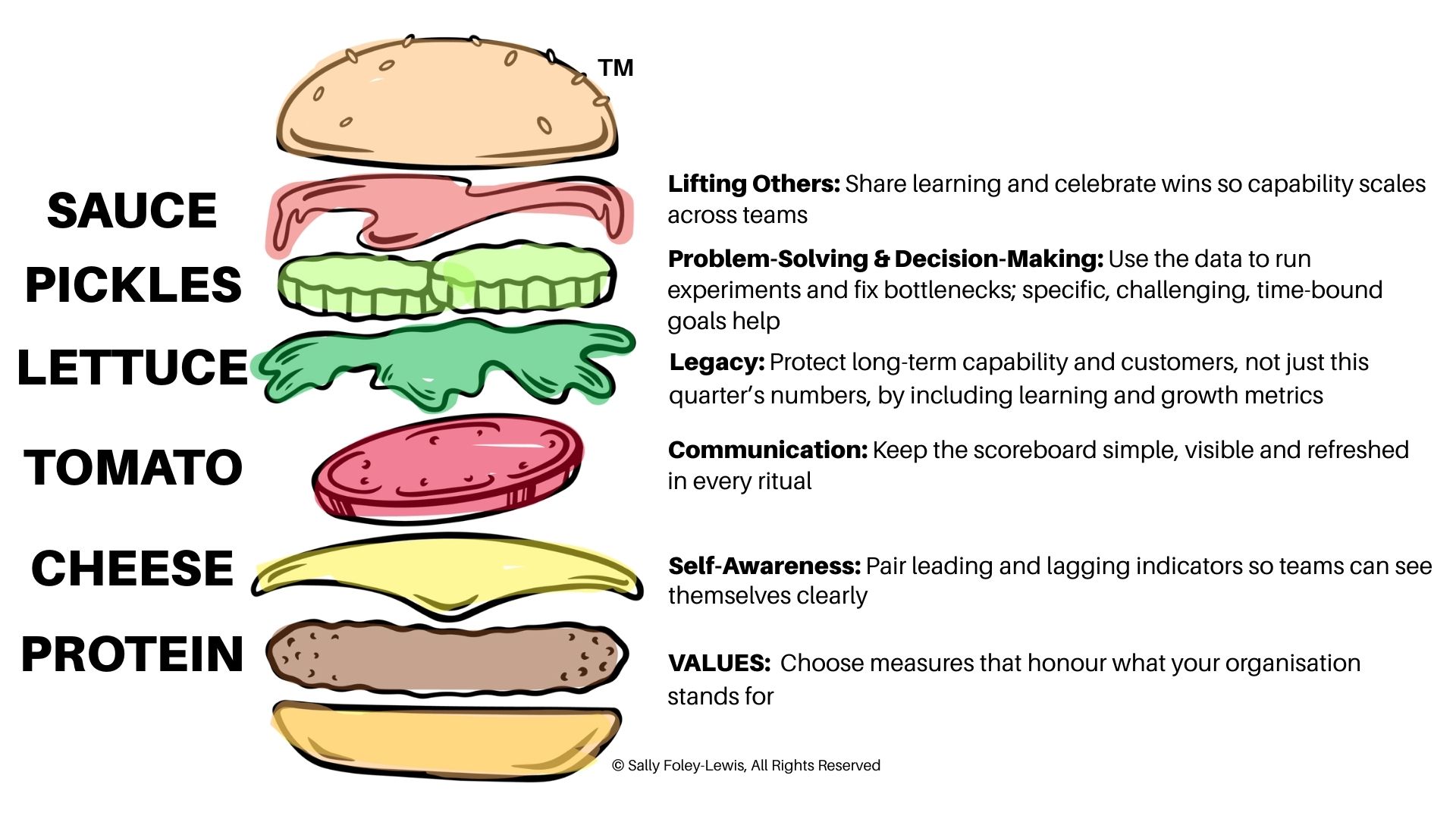
Build the Burger: six leadership ingredients for a great scoreboard
What happens if strategy doesn’t mirror or you don't measure:
Activity trap. You get busyness, not value, because people optimise task counts, not outcomes. Balanced Scorecard research warned us about over-indexing on financial or volume measures alone.(2)
Goal confusion.Without line of sight, effort fragments and engagement drops.
Short-termism.You hit today’s target while eroding tomorrow’s customer value and capability.
Back to the burger line
McDonald’s story is a reminder: if your strategy evolves, your metrics must evolve with it. “Made For You” refocused measurement on freshness and made-to-order compliance while preserving core pillars like speed and accuracy. The shops that tracked and coached to those measures improved exactly where the strategy asked them to. That is the mirror effect your team needs. (1)
Ask you team what they see needs to be measured, that might just be a surprising, productive and profitable conversation!
Let me know how you get on.
...
Sources:
1. https://journalrecord.com/1998/06/04/mcdonald39s-new-system-is-39made-for-you39
2. https://hbr.org/1992/01/the-balanced-scorecard-measures-that-drive-performance-2
3. https://www.qsrmagazine.com/story/the-2025-qsr-drive-thru-report
4. https://med.stanford.edu/content/dam/sm/s-spire/documents/PD.locke-and-latham-retrospective_Paper.pdf
