How big is your belief dividend?
When Megan Allison joined Starbucks at 18, she was juggling shifts and survival after ageing out of foster care. A manager kept saying, “I believe in you. Let’s map a path.” That belief became visible when Starbucks backed her to join the Starbucks College Achievement Plan with Arizona State University, covering tuition. Working full time while studying was tough, yet she earned an associate degree, progressed to store manager, then completed a bachelor’s in psychology in May 2025. She credits the programme with confidence, capability and a clear route to keep growing in the company. Her commitment rose with every step of support. It is belief, made visible, repaid with loyalty and discretionary effort. (1)
The leadership signal that earns commitment
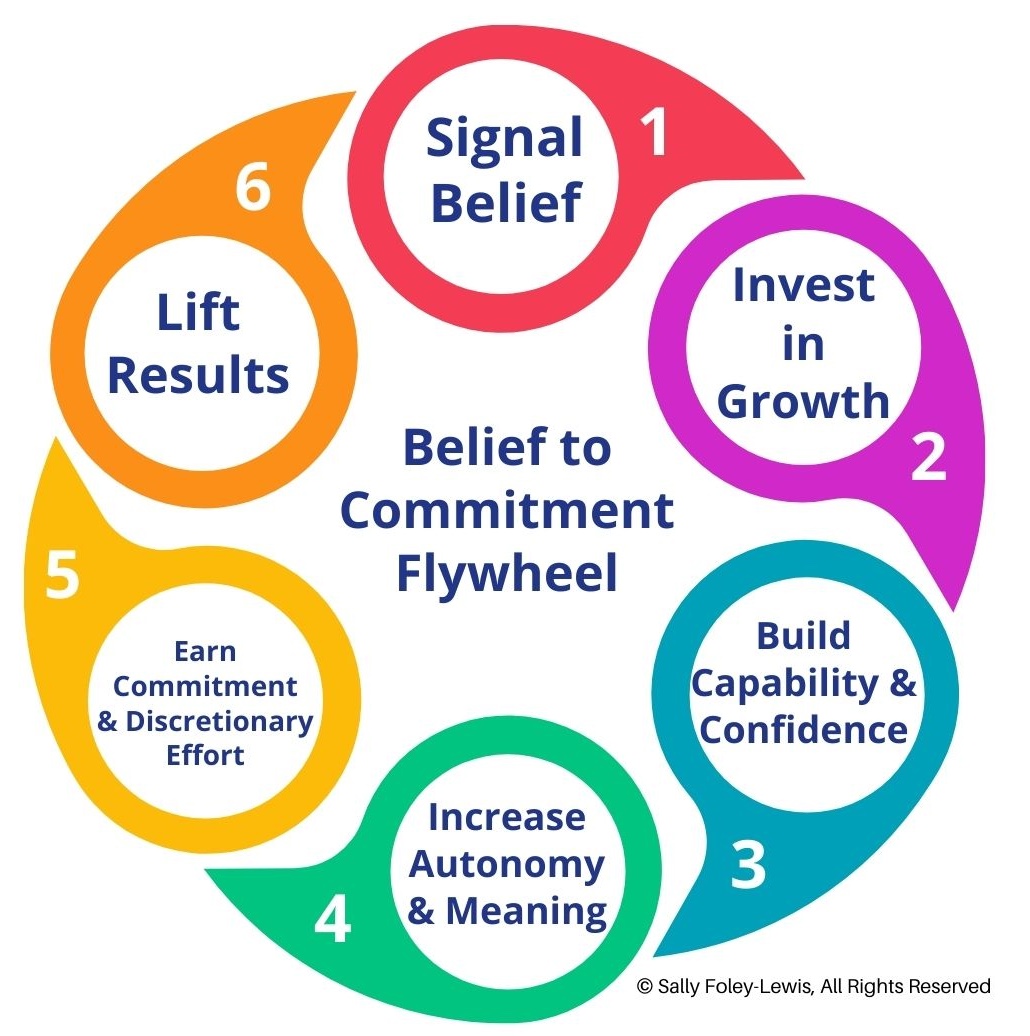
When managers invest in people’s growth, they send a powerful signal: “I see your potential.” That signal triggers reciprocity. People respond with effort, persistence and staying power. The research backs the flywheel.
Organisations that prioritise learning see stronger retention, internal mobility and adaptability, according to LinkedIn’s Workplace Learning Reports. (2)
A UK Government rapid review concludes that learning and development is positively associated with engagement, wellbeing, attraction and retention. (3)
The cost of not signalling belief is severe. Gallup estimates disengagement drains about 8.8 trillion US dollars globally. (4)
This is not a soft sentiment. It is managerial cause and effect. The Pygmalion effect, demonstrated across education and work, shows that higher leader expectations produce higher subordinate performance. (5)
Proof in practice
McDonald’s institutionalised capability building through initiatives such as Hamburger University and broader learning programs. (6) Check out the Archways to Opportunities that McDonald’s Australia have launched, (7) in partnership with Torrens University.
Shake Shack has publicly tied investments - ten million dollars - in wages, retention bonuses and leadership development to attraction and retention outcomes. (8). In the fiscal year 2024, the company's overall annual ROI improved to 0.71% compared to the prior year, partly due to net income growth. The overall goal of the investment, according to a google search, was to create a more stable and experienced workforce, which leads to better customer satisfaction, operational efficiency, and, eventually, improved financial performance. These benefits are often long-term and difficult to isolate as a single ROI figure. Market Chameleon reports, Shake Shack delivered a notable performance for the third quarter of 2025, reporting a net income of $13.7 million versus a net loss of $11.1 million in the same period last year.
The Belief → Commitment Flywheel in action
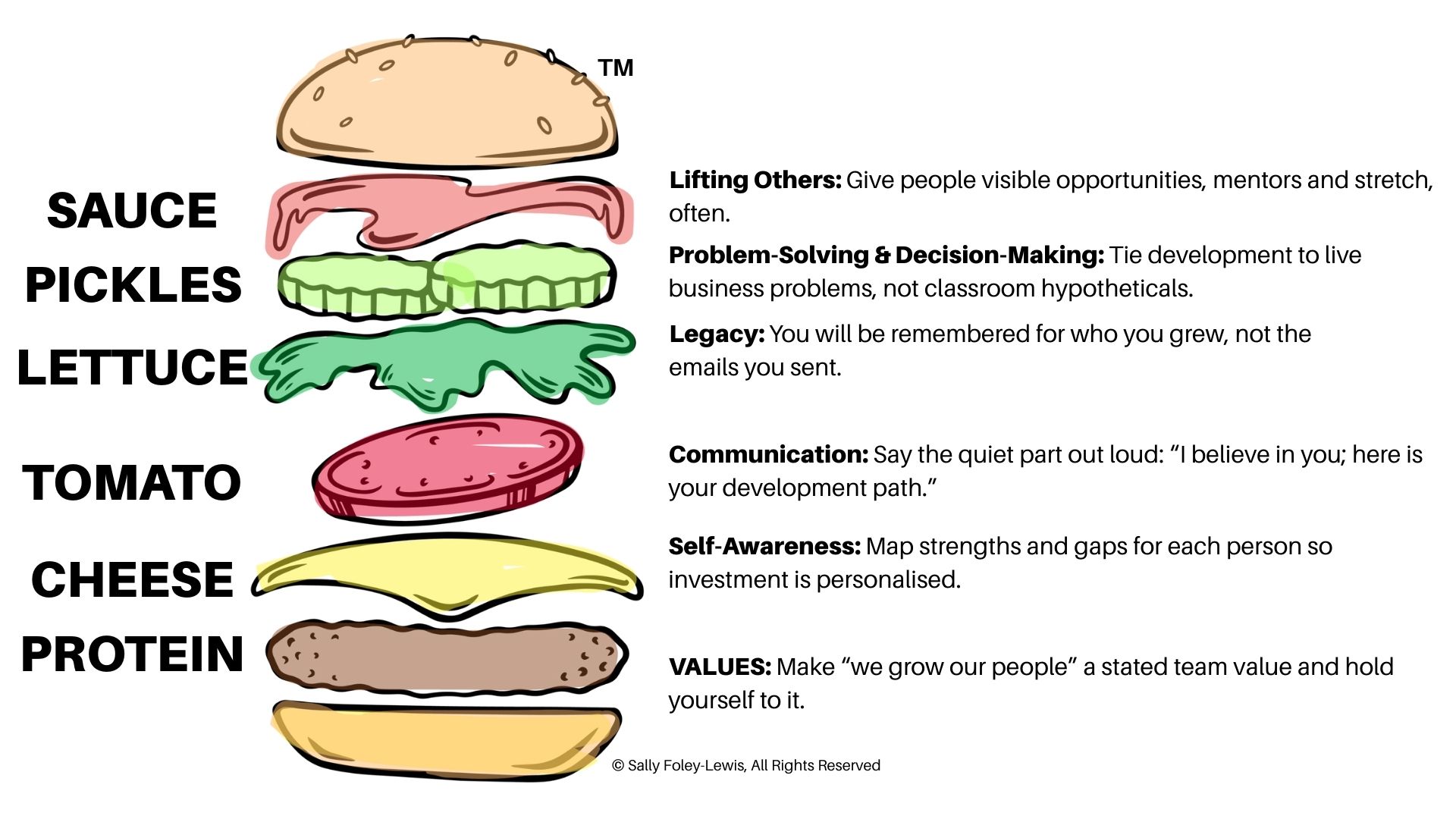
Your Leadership Burger Framework: the ingredients that make belief tangible
Putting this into practical terms for a busy middle-manager
Here are some suggestions for how you can apply this belief to commitment:
Quarterly career conversations. Ask, “What do you want to be better at in 90 days?” Capture one skill, one exposure, one experience, then review.
Micro-budget, macro-signal. Ring-fence a small learning budget per person and use it in frequent, visible bursts. LinkedIn’s (9) reports show consistent access beats sporadic big-ticket courses. This is why my leadership development program is much more than a single workshop and has recorded ROI of 1:12, 1:13 and 1:22 (i.e. for every one dollar invested X dollars are reported as gained), and in one cohort, 64 days in productivity gained.
70-20-10* in the flow of work. Pair a live problem with a mentor and a short course to close gaps.
Set high expectations, coach weekly. Make standards clear and explain why you believe they can meet them.
Track leading indicators: Uptake of stretch tasks, internal applications, mentoring participation and employee Net Promoter Scores are early signals of commitment.
Tell growth stories: Spotlight internal promotions and skills wins. The stories you tell publicly become the culture you scale.
Why bother?
If you ignore this stagnation can easily and quickly creep in, skills atrophy and avoidable errors rise. Engagement stalls, wellbeing dips and people leave for growth elsewhere. The drag on performance is measured every year in Gallup’s data and reported widely. (10) A managerial fix is to invest in manager development and consistent conversations. (11)
Bring it home
Megan’s journey shows the human side of a hard-edged truth. Investing in growth is not a perk. It is a leadership practice that signals belief, builds capability and earns commitment. Prioritise it, systematise it (but don’t remove the human element), and put it on repeat, and the flywheel will turn faster.
I’d love to know your thoughts.
...
Source:
1.https://www.businessinsider.com/starbucks-employee-free-college-degree-through-company-2025-6
2.https://learning.linkedin.com/resources/workplace-learning-report
3.https://www.gov.uk/government/publications/learning-and-development-employee-engagement-and-wellbeing
4.https://www.forbes.com/sites/karadennison/2024/07/16/gallup-says-88-trillion-is-the-true-cost-of-low-employee-engagement/and Gallup’s State of the Global Workplace hub:https://www.gallup.com/workplace/349484/state-of-the-global-workplace.aspx.
5.https://www.changefactory.com.au/our-thinking/articles/managing-performance-pygmalion-effect-leadership/
6.https://trainingindustry.com/articles/workforce-development/case-study-how-mcdonalds-integrates-learning-into-the-employee-experience/
7.https://mcdonalds.com.au/newsroom/uni-credits-menu-mcdonalds-australia
8.https://shakeshack.com/blog/our-team/shake-shack-investing-more-than-10m-in-restaurant-teams
9.https://learning.linkedin.com/resources/workplace-learning-report
10.https://www.gallup.com/workplace/349484/state-of-the-global-workplace.aspx
11.https://www.wsj.com/lifestyle/careers/managers-engagement-work-e50f8f5e
*70-20-10: The 70-20-10 principle is a popular framework for workplace learning, suggesting that people learn most effectively through a blend of experiences: 70% from on-the-job challenges, 20% from interactions with colleagues (social learning, coaching, mentoring), and 10% from structured, formal training like courses or reading. Developed by the Center for Creative Leadership, it emphasizes hands-on, practical learning and collaboration over traditional classroom methods to build skills for high performance. [Source: Google]
