Cadence over chaos: how rhythms build trust and speed
On a busy Friday in Brisbane, a restaurant manager gathers the team for a five-minute pre-shift huddle. Specials, VIP bookings, safety notes, who is on pass, who watches allergens, plus one tiny reminder to delight customers. When this cadence slips and updates become “tell people when you bump into them,” tickets stack up, errors creep in, and service lags. Operators repeatedly report that consistent pre-shift rhythms lift alignment, morale, and execution shift after shift. Guides for venue leaders make the same point: brief, structured huddles reduce rework and delay while improving guest experience (1) and a repeatable template can help managers keep teams on track. You can borrow ideas from Running Restaurants, “The Pre-Shift Huddle Sheet,”(2)
Cadence creates predictability, which people read as reliability. In trust research, reliability flows from consistent, competent, benevolent behaviour. That combination increases the willingness to be vulnerable, the heart of trust. (3) When communication is cadenced, stakeholders know when and how they will hear from you, which lowers coordination costs and anxiety.
Why cadence accelerates teams
Daily stand-ups are one of the most studied team cadences. A grounded theory study of 12 software teams found stand-ups enhance information sharing, surface roadblocks faster, and support problem solving, all of which show up as precursors to performance. (4)
Psychological safety, which underpins learning and speed, is also strengthened by regular, structured forums where people can speak up without fear. (5)
Cross-functional work especially benefits. Harvard Business Review (6) notes that many organisations suffer collaboration drag from unclear decision rights and messy touchpoints; a defined operating cadence is a practical antidote. Collaboration drag, according to the article can include: “too many meetings, too much peer feedback, unclear decision-making authority, and too much time spent getting buy-in from stakeholders.” Like a great burger, the right mix of ingredients, it’s about finding the right balance of collaborative activities.
Cadence also helps you manage up. Roblox engineering SVP Sebastian Barrios sends a crisp weekly recap to the CEO covering outcomes, next week’s focus, risks or asks, and team wins. He reports it streamlines one-to-ones and frees them for strategy while keeping alignment tight (7). This habit is easy to emulate and it reduces random status pings that interrupt deep work.
Middle managers are perfectly positioned in organisations when it comes to powerful communication. They can inspire down, collaborate across and influence upwards. See the Chaos to Cadence Matrix.
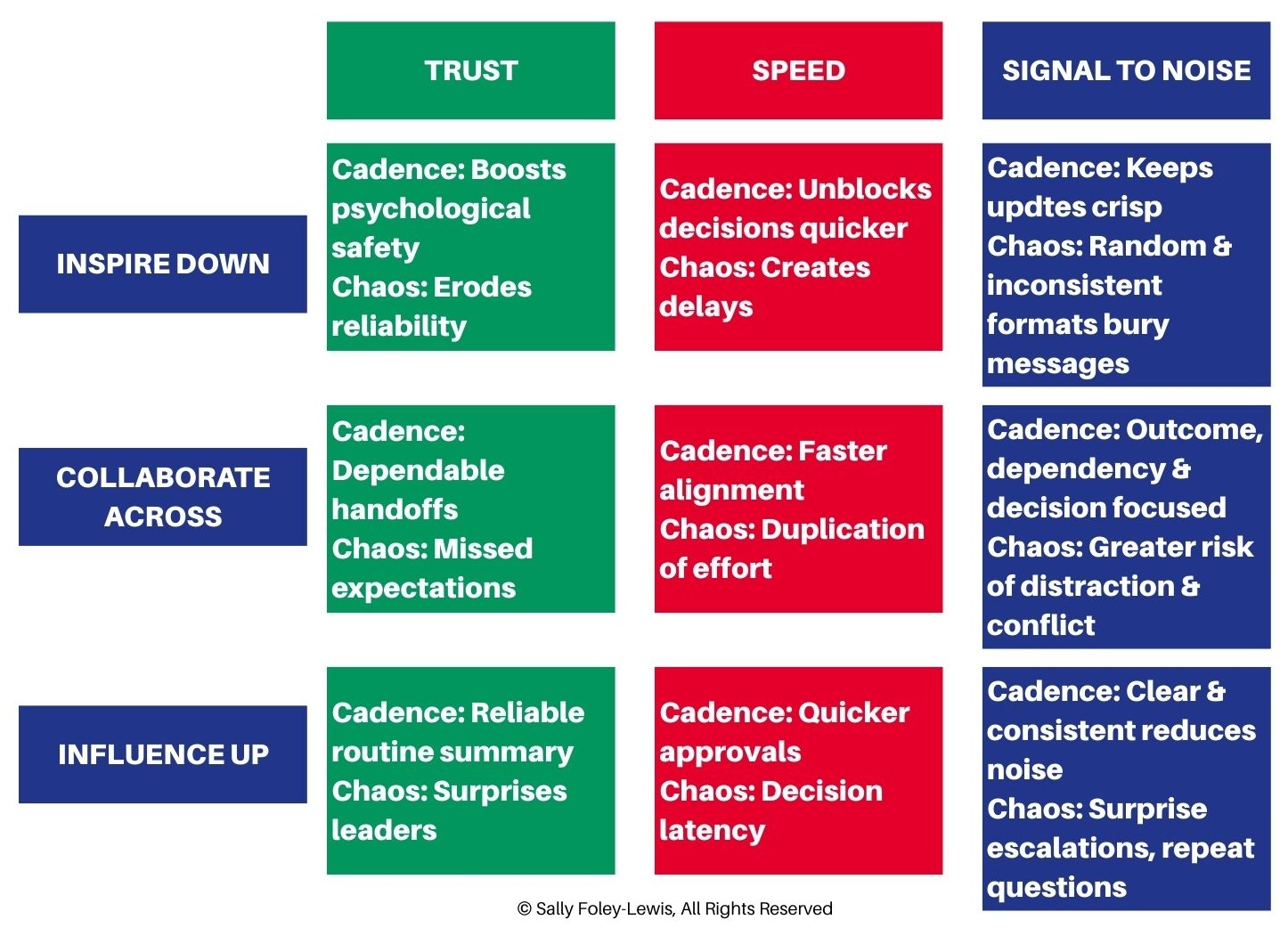
In every cell, cadenced touchpoints increase the outcome; ad hoc communications decrease it. For example:
Inspire Down: a weekly team rhythm boosts psychological safety and perceived reliability
Collaborate Across: short, scheduled cross-functional huddles unblock decisions quickly
Influence Up: a crisp weekly summary to your boss reduces random pings and rework
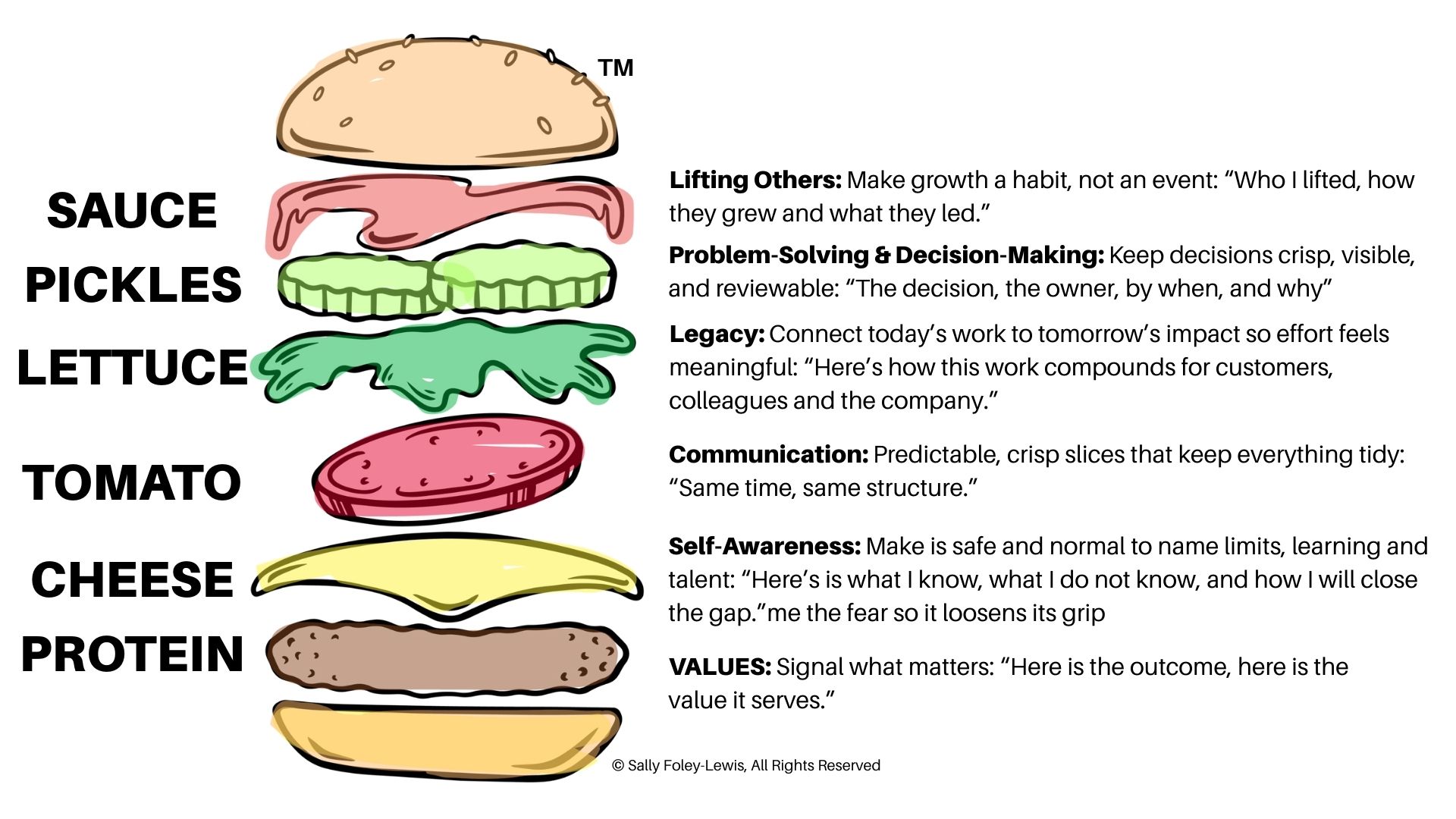
The Leadership Burger: make the tomato count
Putting this into your day to day
Here are a few suggestions for how you can apply this through your day to day:
Inspire Down
Daily 10-minute stand-up: yesterday, today, blockers. Standing, time-boxed, and strictly team-focused.
Weekly 30-minute priorities sync: review goals, metrics, and risks; confirm who owns which decision by when.
Monthly 60-minute retrospective: start, stop, continue; connect improvements to VALUES and to LIFTING OTHERS.
Collaborate Across
Weekly 15-minute cross-functional huddle: one slide, same sections each week, focus on handoffs and dependencies.
Fortnightly 30-minute decision review: only decisions that cross team boundaries; pre-read due 24 hours prior.
Shared cadence calendar visible to all to avoid meeting creep.
Influence Up
Friday morning five-minute weekly summary to your boss and key stakeholders: top outcomes, next week’s focus, risks or asks, spotlight on team wins.
Quarterly narrative: a concise story of progress against strategy, customer impact, and prudent course corrections. Roll up your weekly notes to avoid rework.
What happens if you do the opposite?
An ad hoc approach only has a high risk of trust eroding because people cannot predict when they will hear from you or how decisions are made. Cross-team work slows down as dependencies surface later and later. Stakeholders interrupt more, adding noise and churn. I refer you to the collaboration drag mentioned above, and this becomes widespread and unproductive when leaders lack a clear rhythm.
I’d love to know your cadences: what is something that you do as a matter of routine?
...
Source:
1.https://www.pushoperations.com/blog/restaurant-management-the-value-of-pre-shift-huddles
2. https://www.runningrestaurants.com/articles/the-preshift-huddle-sheet-tips-restaurants
3. https://makinggood.ac.nz/media/1270/mayeretal_1995_organizationaltrust.pdf
4. https://www.sciencedirect.com/science/article/abs/pii/S0164121216000066
6. https://hbr.org/2024/06/why-cross-functional-collaboration-stalls-and-how-to-fix-it
