Are you serving up confusion?
Across nine hospitals, doctors changed how they handed over patients. The intervention did not rely on a motivational speech about communicating better. It gave clinicians a shared structure for transferring responsibility, supported by training, observation and feedback.
The I-PASS study, reported in 2014 by Amy Starmer, Nancy Spector and colleagues, covered 10,740 patient admissions. Following implementation, medical errors fell by 23% and preventable adverse events by 30%. Oral handovers did not take significantly longer. These were improvements associated with a bundled program, not proof that a few clearer sentences alone produced the results. (1)
For middle managers, the story poses a useful question: how much trouble starts when responsibility changes hands, but understanding does not?
You do not need to work in healthcare to recognise the problem. A customer request moves between departments. A deadline changes. Someone assumes someone else has told the team. Eventually, the issue lands on a manager’s desk wearing its best “urgent” outfit.
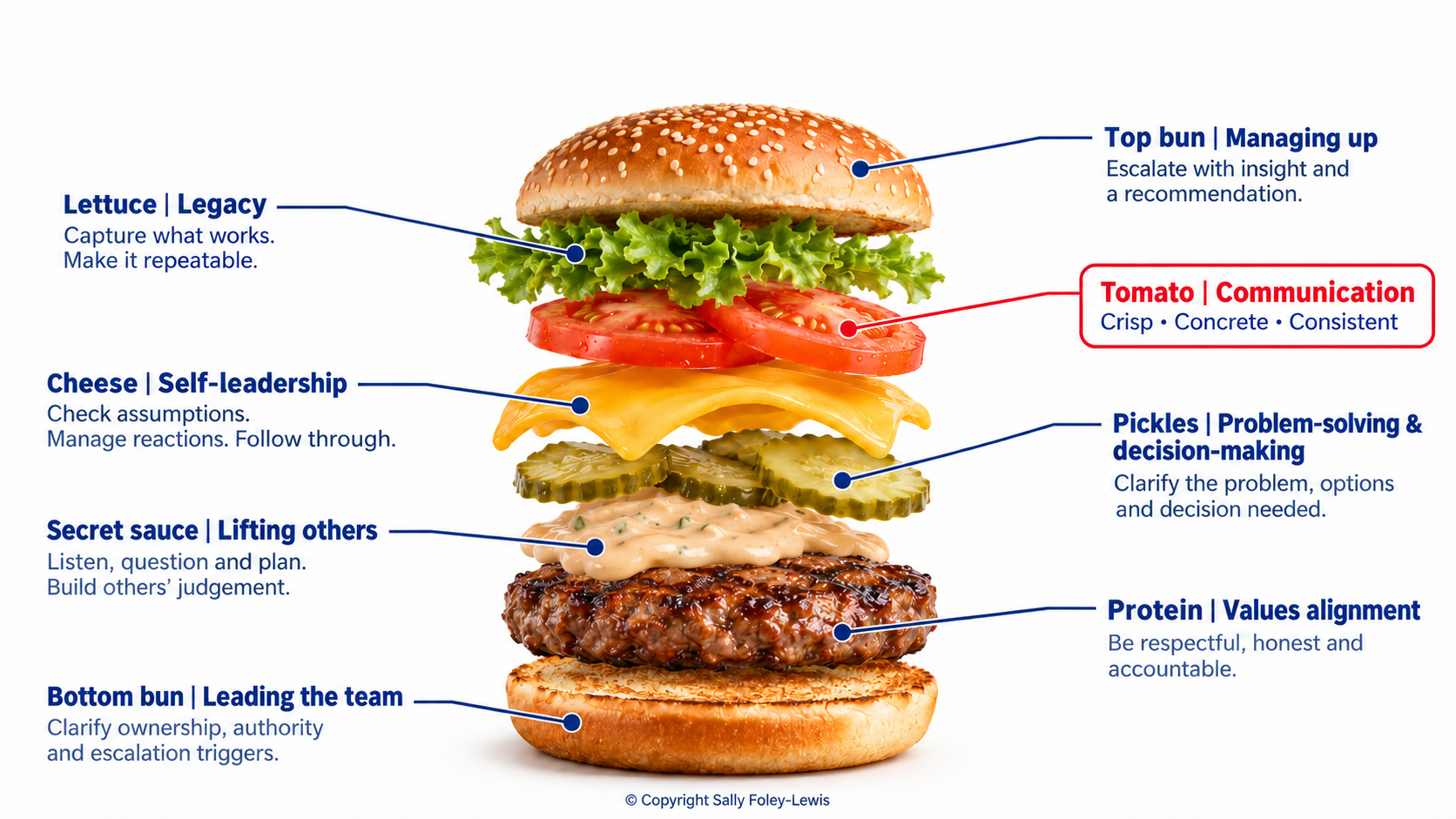
My Leadership Burger Framework puts communication in the tomato layer. It needs to be fresh, visible and easy to work with. However impressive the other ingredients, a slippery communication layer can make the whole stack difficult to hold.
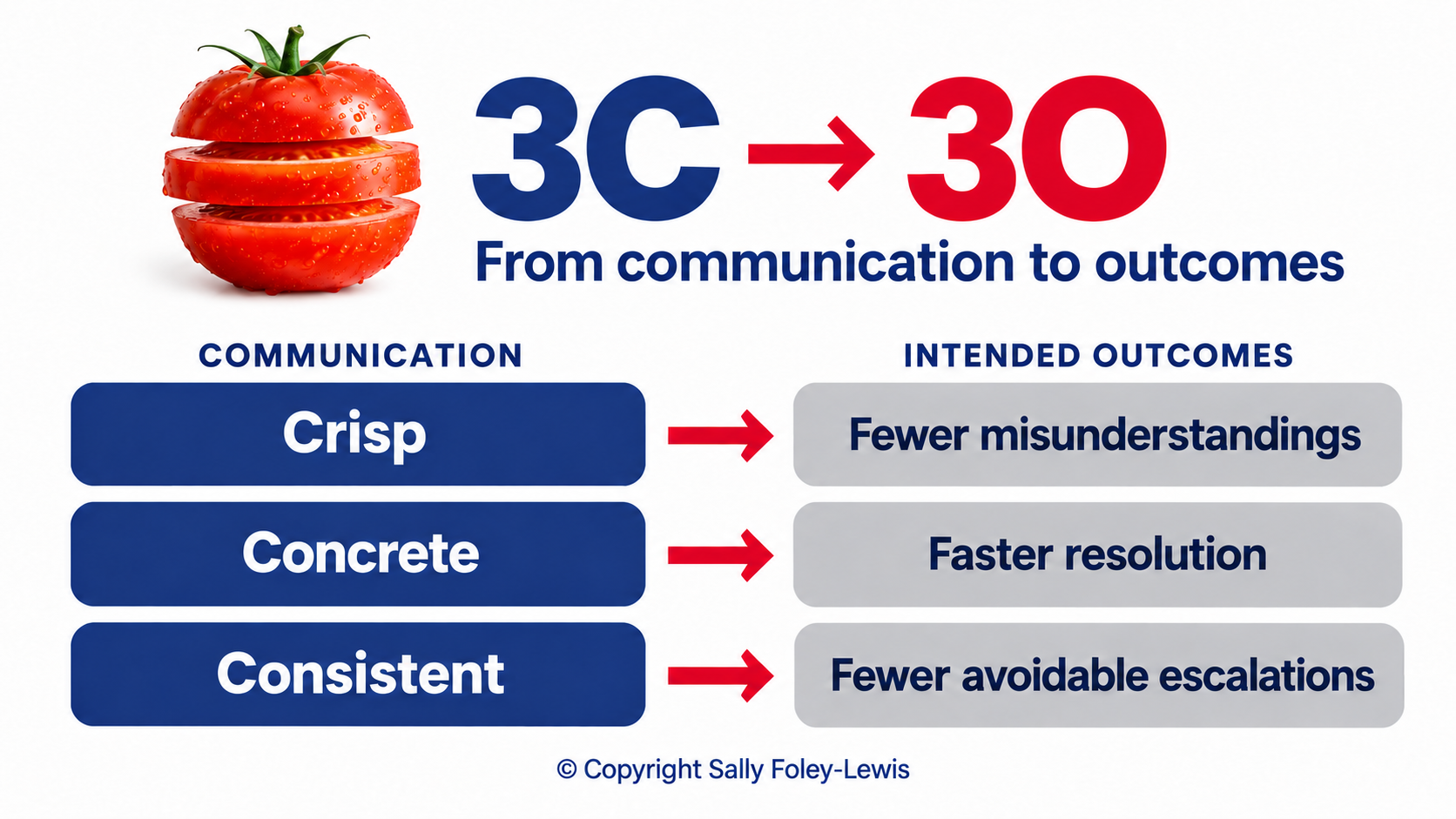
Crisp: make the point easy to find
Crisp communication gives people the essential information without making them excavate it.
Lead with what has happened, why it matters and what needs to happen next. Add background when it changes the decision. Brevity should remove clutter, never critical detail.
Healthcare offers a useful structure: SBAR, meaning Situation, Background, Assessment and Recommendation. The Institute for Healthcare Improvement describes it as a way to organise communication about a patient’s condition. Managers can adapt that sequence for operational updates, while recognising its clinical origins. (2)
Instead of forwarding twelve emails with “Thoughts?”, explain the issue and the decision required. Your colleagues have jobs. Email archaeology should not become another one.
Concrete: give the message somewhere to go
“Please sort this out ASAP” sounds decisive. It leaves the action, owner and deadline open to interpretation.
For illustration: “Jordan, confirm the revised delivery date with the supplier by 2 pm, update the customer record, and tell me if the delay exceeds one working day.”
Now the recipient knows what to do, when to do it and when additional authority is needed.
Ask them to summarise the agreed next step. Treat this as checking your explanation, rather than testing their intelligence.
Keep the evidence in perspective. Martin Müller, Stephanie Stock and colleagues reviewed 11 studies of SBAR and patient safety. They found moderate evidence of benefit, particularly for telephone communication, but highlighted limitations in study quality. That supports thoughtful use of structured communication; it does not establish a guaranteed reduction in workplace escalations. (3)
Consistent: make the current answer findable
Consistency means agreeing where authoritative updates live, who maintains them and when people should expect changes.
Choose a shared record appropriate to the work. If priorities shift, update that record and alert the affected people. Repeating yesterday’s message confidently is not consistency; it is yesterday’s mistake with better posture.
Agree escalation triggers, too: a safety concern, a spending limit, a missed milestone or a decision beyond someone’s authority. Make these explicit before pressure arrives.
Bring the other ingredients into the conversation: values set the standard for respect; self-leadership helps you practise it; problem-solving clarifies the decision; legacy preserves useful improvements; and lifting others develops their capability. Communication connects those efforts. A template can prompt better conversations, but managers still need to listen, exercise judgement and follow through on agreed actions.
Keep the route upward open
Fewer escalations should never mean fewer people speaking up.
Amy Edmondson’s study of 51 manufacturing teams found that psychological safety was associated with team learning behaviour. Her research gives managers a reason to examine whether people feel able to ask questions and acknowledge mistakes. (4)
My practical implication: respond constructively when someone flags uncertainty. Otherwise, your beautifully organised communication system may simply help problems stay hidden.
Build a better communication layer
Start with one recurring handover or escalation. Review whether the message identified the issue, action, owner, deadline and escalation trigger. Then improve that exchange using the three Cs.
Track avoidable escalations alongside rework, resolution time and timely reporting of genuine risks. A lower escalation count alone cannot tell you whether performance improved.
The aim is a team that knows what to do, can act within its authority, and recognises when to seek help. That is communication earning its place in the burger: holding the work together, one clear exchange at a time.
Let me know how you get on.
...
Source:
https://bmjopen.bmj.com/content/8/8/e022202
https://doi.org/10.2307/2666999
https://www.ihi.org/library/tools/sbar-tool-situation-background-assessment-recommendation
